Buyer's guide · Prices checked October 29, 2026
Best AI Visibility Tools 2026: 8 Compared, and How to Choose
The best AI visibility tool depends on your budget and on what you need after the report. Here are 8 tools with real prices, then the checklist and the questions to ask before you pay.
 By the Howseen team · Updated

3-day free trial, cancel in 1 click. Plans from €39 per month, billed in euros, with your data stored in the EU (Frankfurt).
Disclosure: Howseen is our product, so we have a stake in this list. To keep it useful, every tool is described on the same six fields, every price was read on the vendor's own pricing page on October 29, 2026, and each entry ends with an honest tradeoff, ours included. We do not link to the vendors; search their names to check.
Short answer
Which AI visibility tool is best in 2026?
It depends on budget and on what you need after the report: Otterly.AI is the cheapest entry, Peec AI the analytics pick, Semrush and Ahrefs fit existing users, Profound fits enterprise, and Howseen fits teams that want the fix published.
- Small business or e-commerce brand, public price, fix included: Howseen, from €39 per month.
- European company (GDPR, EU data, billing in euros): Howseen, with its database and app servers in Frankfurt and plans priced and billed in euros; see our GDPR checklist.
- Lowest entry price for a few prompts: Otterly.AI Lite at $29 per month for 15 prompts.
- Analytics with unlimited users: Peec AI from $95 per month for 50 prompts.
- Already on Semrush or Ahrefs: their add-ons, $99 per domain per month (billed annually) and from $199 per month.
- Enterprise team with SSO and SOC 2 needs: Profound or the enterprise plans of Scrunch and AthenaHQ, priced on request.
Video
The comparison in under 3 minutes
The 8 AI visibility tools compared on price, engines covered and what happens after the report, in under 3 minutes.
Prices
How do the 8 AI visibility tools compare on price?
Self-serve entry prices run from $29 to $295 per month, Howseen starts at €39, and Profound shows no public paid price. The bigger gap is what the entry plan includes: engines, prompts and what happens after the report.
| Tool | Entry price (checked Oct 29, 2026) | AI engines | After the report | Free trial | For agencies |
|---|---|---|---|---|---|
| Howseen (ours) | €39/mo (20 prompts) | 3 on Starter, 5 on Pro, 6 on Business | Writes and publishes the fix to your CMS | 3 days | White-label reports on Business, or from 2 paid sites |
| Otterly.AI | $29/mo (15 prompts) | 4 included; Gemini, AI Mode, Claude as add-ons | Recommendations and audits | Yes (length not stated) | Agency Partner program (special pricing) |
| Peec AI | $95/mo (50 prompts) | 3 of your choice; more as add-ons | Recommendations and agent actions | Yes (length not stated) | Separate agency plans, priced in credits |
| Semrush AI Visibility Toolkit | $99/mo per domain, billed annually (25 prompts) | ChatGPT, Google AI, Gemini, Perplexity | Research and AI-readiness audit | 7 days (Semrush-wide) | Pro Report add-on ($20/mo) with branding and white-labeling |
| Ahrefs Brand Radar | from $199/mo (packages from $50/mo) | Per check (prompt x platform x location) | Research; content add-ons separate | No (Ahrefs Free for site owners) | Not shown on the pricing page |
| Scrunch | $250/mo (125 prompts) | 4 on Core, 9 on Enterprise | Page optimizations, basic content | 7 days | For agencies tab, no price in the page text |
| AthenaHQ | $295/mo (3,600 credits); free tier | 11 on Starter | Actions and content agent | Free tier (300 credits) | Enterprise and agencies on custom plans |
| Profound | Custom (Enterprise); free trial | 3 on the trial, up to 9 on Enterprise | AI Marketer agents (credits) | 7 days, 50 prompts | Agency Growth plan, price not public |
A prompt is one buyer question tracked over time. Compare plans on prompts per engine per month, not on the headline price: 15 prompts on 4 engines and 50 prompts on 5 engines are not the same purchase.
The 8 tools
The 8 AI visibility tools, one by one
Each tool below is described on the same six fields: who it fits, price, engines, what it does after the report, trial and an honest tradeoff, so you can compare like with like.
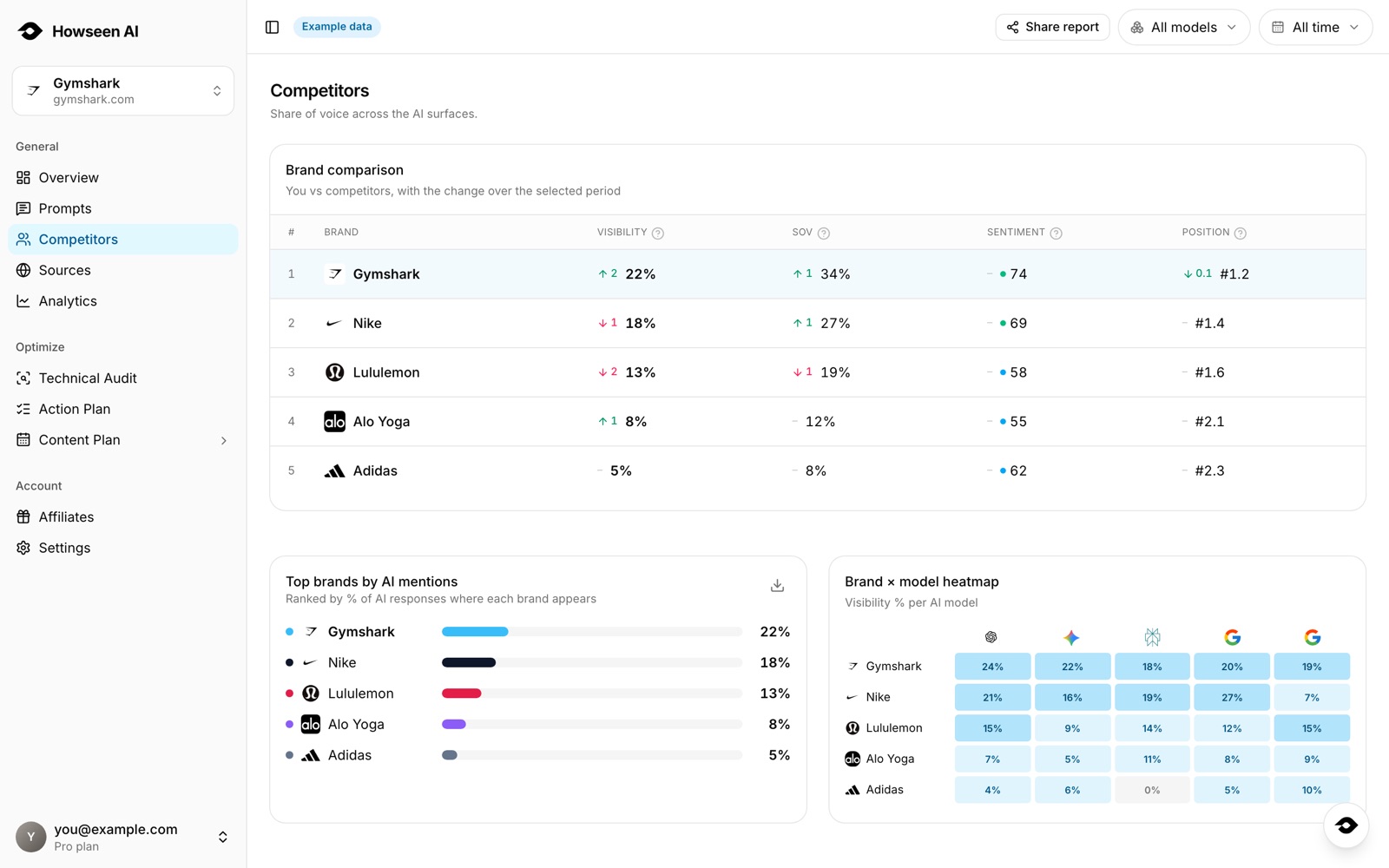
1. Howseen Our product
Our pick for small businesses and agencies that want the gap closed, not only measured. Listed first because it is ours: judge it on the same fields as the others.
Best for: small businesses, e-commerce brands and agencies that want the tracking and the fix in one tool, at a public monthly price in euros.
Price: Starter €39 per month (20 prompts), Pro €79 per month (50 prompts), Business from €219 per month (100 to 300 prompts shared by 3 brands). Yearly billing: €31 and €63 per month.
AI engines: Starter: ChatGPT, Gemini and Google AI Overviews. Pro adds Perplexity and Google AI Mode. Business adds Claude.
After the report: Shows who AI names instead of you and which sources it reads, then writes articles and publishes them to WordPress, Shopify, Webflow, Wix, Ghost or BigCommerce, or to any site through a webhook. Action plan, REST API and MCP server.
Free trial: 3 days, cancel in 1 click.
Honest tradeoff: a young company, so most of the proof is our own data; no SSO or enterprise security package; Starter and Pro check every 3 days (Business daily); sources, sentiment and the API start on Pro; Claude only on Business.
2. Otterly.AI
The cheapest serious entry in this list. Count the add-ons before you compare it with plans that include Gemini and Google AI Mode.
Best for: the lowest entry price when you track a handful of prompts.
Price: Lite $29 per month (15 prompts), Standard $189 (100 prompts), Premium $489 (400 prompts); 15% off yearly.
AI engines: ChatGPT, Google AI Overviews, Perplexity and Microsoft Copilot are included. Gemini, Google AI Mode and Claude are paid add-ons (on Lite: $9, $9 and $29 per month).
After the report: Recommendations, GEO audits and crawlability checks. API and MCP access from Standard.
Free trial: offered (length not stated on the pricing page).
Honest tradeoff: the real price depends on the engines you add, and 15 prompts is a narrow sample of your buyers' questions.
3. Peec AI
The analytics-first choice, with unlimited users on every plan and a deep feature table.
Best for: marketing teams that want detailed analytics with unlimited users.
Price: Starter $95 per month (50 prompts), Pro $245 (150 prompts), Advanced $495 (350 prompts), Enterprise custom. Agency plans are sold in credits.
AI engines: 3 models of your choice on Starter, Pro and Advanced (ChatGPT, Gemini, Google AI Mode, AI Overviews, Microsoft Copilot and more); extra models are paid add-ons; up to 13 on Enterprise.
After the report: Gap analysis, recommended actions and agent actions, AI referral and crawler analytics. MCP on every plan, API from Pro, SOC 2.
Free trial: offered (length not stated on the pricing page).
Honest tradeoff: 3 models per self-serve plan, so covering every engine costs extra; we did not find publishing to your own CMS on its pricing page.
4. Semrush AI Visibility Toolkit
The convenient choice if your keywords, backlinks and audits already live in Semrush.
Best for: teams that already run their SEO in Semrush.
Price: $99 per month per domain, billed annually (25 custom prompts). Extra users from $45 per month.
AI engines: ChatGPT, Google AI, Gemini and Perplexity.
After the report: Prompt and competitor research, a site audit for AI readiness; content work lives in other Semrush toolkits.
Free trial: Semrush advertises a 7-day free trial on its pricing page.
Honest tradeoff: cost grows with every domain, and 25 prompts per domain is a small sample.
5. Ahrefs Brand Radar
The research choice: see how any brand shows up across a very large prompt database.
Best for: market research: how any brand appears across a very large database of prompts.
Price: Brand Radar AI from $199 per month. Prompt packages to track only your own prompts: $50 per month (2,500 checks), $100 (7,000) or $250 (25,000), overage billed per check.
AI engines: billed per check: one prompt, on one platform, in one location, uses one check.
After the report: Research and tracking; content tools are separate Ahrefs add-ons.
Free trial: Ahrefs says it never runs discounts and points site owners to its free webmaster tool instead of a trial.
Honest tradeoff: built for research, not for writing or publishing the fix; checks run out fast if you track many prompts on several engines daily.
6. Scrunch
The technical choice, centred on how AI agents read your pages.
Best for: teams focused on how AI agents read and render their site.
Price: Core $250 per month (125 prompts, 5,000 responses, 5 site audits, 5 users); Enterprise custom.
AI engines: Core: ChatGPT, Perplexity, Google AI Overviews and Microsoft Copilot. Enterprise: 9, including Claude, Gemini and Google AI Mode.
After the report: Insights and recommendations, 1 page optimization per month and basic content generation on Core; its Agent Experience Platform, API and SSO on Enterprise.
Free trial: 7 days on Core.
Honest tradeoff: Gemini and Google AI Mode need Enterprise, and the content side is light on Core.
7. AthenaHQ
The action-center choice, with many models and a credit meter.
Best for: teams that want an action center billed in credits.
Price: Essential free (300 credits, $25 of credit), Starter $295 per month (3,600 credits, 1 credit = 1 AI response), Enterprise custom; 17% off yearly.
AI engines: 11 models on Starter, including ChatGPT, Perplexity, Google AI Overviews, AI Mode, Gemini, Claude, Copilot and Grok.
After the report: On-page and off-page actions and a content optimization agent. API access and extra credits are paid add-ons.
Free trial: a free Essential tier instead of a trial.
Honest tradeoff: every AI response uses a credit, so many prompts on 11 models burn the 3,600 credits quickly.
8. Profound
The enterprise choice: the widest engine list and enterprise security, priced after a demo.
Best for: enterprise teams that need many engines, SSO and SOC 2, with a budget for a custom contract.
Price: a free trial, then Enterprise at a custom price (“Tailored packages”). An Agency Growth plan is mentioned, without a public price.
AI engines: Trial: ChatGPT, Gemini and Google AI Overviews. Enterprise: up to 9 answer engines, including Perplexity, Google AI Mode, Microsoft Copilot, DeepSeek and Claude.
After the report: AI Marketer agents that research and write, billed in credits; agent analytics for AI-sourced traffic; API, exports and full history on Enterprise.
Free trial: 7 days, 50 prompts chosen by Profound, run daily.
Honest tradeoff: no public paid price; on the trial you cannot edit the prompts and you get no history, exports or API.
See where AI names you before you compare tools
Run a free check on your brand, or start a 3-day trial of Howseen on your own buyer questions.
3-day free trial, cancel in 1 click. Plans from €39 per month, billed in euros, with your data stored in the EU (Frankfurt).
What AI answers
Which AI visibility tools do ChatGPT, Gemini and Google AI recommend?
Asked for the best tool to monitor AI search visibility, the six engines we track named Semrush and Profound most often over the last 30 days, then Peec AI, Ahrefs Brand Radar and OtterlyAI.
We ask “Best tool to monitor AI search visibility” to ChatGPT, Claude, Gemini, Perplexity, Google AI Mode and Google AI Overviews on a schedule, in our own Howseen account. Over the 30 days to October 29, 2026, 55 answers came back. The tools they named most often:
- Semrush: named in 34 of 55 answers
- Profound: named in 33 of 55 answers
- Peec AI: named in 11 of 55 answers
- Ahrefs Brand Radar: named in 10 of 55 answers
- OtterlyAI: named in 7 of 55 answers
These counts describe what the engines say today, not a quality verdict. A tool the engines name often has strong third-party coverage (rankings, reviews, videos); it does not tell you which tool fits your budget. That is what the table above is for.
Definition
What is an AI visibility tool?
An AI visibility tool tracks how often your brand appears inside AI-generated answers, on platforms like ChatGPT, Perplexity, Gemini and Google AI Overviews. It measures whether you are mentioned, how you are positioned, what sentiment the model expresses, and which competitors are named instead of you.
Think of it as rank tracking, but for AI answers, not blue links. Traditional SEO tools tell you where you rank on Google. AI visibility tools tell you whether you exist when a buyer asks an AI engine for the best tool in your category. Those are two very different questions, and the answer to the second one is increasingly what drives the purchase.
Coverage
What a good tool should track
Five AI surfaces and five metrics are the baseline. A tool that skips one engine or one metric leaves a blind spot, so check both lists against any plan you consider.
ChatGPT
The world's most-used AI assistant, now a primary product discovery channel for millions of buyers.
Perplexity
The AI search engine that cites sources directly and drives high-intent research traffic.
Gemini
Google's AI model, embedded across Search, Workspace and mobile.
Google AI Overviews
The AI-generated summaries that now appear above organic results for most commercial queries.
Google AI Mode
Google's full conversational search experience, rolling out globally.
Refresh cadence
AI answers move, so ask how often each metric refreshes. Howseen refreshes every 3 days, or daily on Business, without waiting for a quarterly report.
The five metrics to insist on, per surface
Visibility score
How often your brand appears across your tracked prompts.
Sentiment
Positive, neutral or negative, per prompt and per model.
Position
Where you appear in ranked or list-style AI answers.
Share of voice
Your visibility versus every tracked competitor, side by side.
Citation sources
The exact domains, pages and source types that feed each AI answer.
The checklist
Five things a good tool does
Score every tool you are considering against these five points. Most tools do some of it well and skip the rest, so weigh each point against what you actually need.
Tracks every engine
Covers ChatGPT, Gemini, Perplexity, Google AI Overviews and AI Mode, not just one of them. Buyers ask different engines, and the answers rarely match.
Traces the sources
Shows which pages and threads the answers are built on, not just a score. Without the sources you know your position but not how to change it.
Competitor share of voice
Tells you who gets named instead of you, per question. The gap between you and the brands the AI keeps recommending is the work.
Turns insight into action
Helps you publish content and fix gaps, not just report them. A dashboard that only measures leaves the hard part to you.
White-label for agencies
If you serve clients, you want multi-client management and reports under your own brand. This matters far less for a single in-house team, so weigh it by who you are.
The decision
How to choose
Choose in four moves: match the tool to your size, decide between action and analytics, check white-label if you serve clients, and test it on your own brand.
Match it to your size
A solo founder or SMB and a large enterprise need different tools. Start by being honest about which you are, so you do not pay for a platform you will not use, or outgrow a tracker in a month.
Decide: action or analytics
Do you have the team to act on the data, or do you want the tool to help you produce content and close gaps? If you just need the numbers, a focused tracker is enough. If you need help doing the work, choose an action-oriented tool.
Agencies: check white-label and multi-client
If you report to clients, confirm you can manage several brands cleanly and send reports under your own name before anything else. It is the feature most likely to make or break the fit.
Try it on your own brand first
Run each shortlisted tool against your real buyer questions before committing. The right one is the one that shows you something useful and actionable about your own brand, not the one with the longest feature list.
On the demo call
Eight questions to ask any vendor
A demo shows the best screen of a product. These questions show the rest: what the price really covers, where the data comes from, and what happens after the report.
- 01Which AI engines are in the base price, and which are sold as add-ons?
- 02What does the plan cost once you add the prompts, seats and sites you really need?
- 03Are the tracked questions your buyers' real questions, or a sample from a generic prompt database?
- 04Can I see the sources behind each answer, not only a score?
- 05Does the tool write or publish the fix, or only recommend it? Which CMS can it publish to?
- 06Can I see a result on my own brand before I pay or sit through onboarding?
- 07For agencies: can client reports go out under my brand, and how do I work across several brands?
- 08How do you measure visits that come from AI assistants, if at all?
The loop
Track, diagnose, fix: ask for the whole loop
Most AI visibility tools stop at a dashboard. Ask whether a tool covers the whole loop, from tracking to the published fix. Here is how Howseen runs it, as one example to compare against.
Track
Add the prompts your buyers actually ask. Howseen suggests high-intent queries from real search data, then runs them across your plan's AI engines every 3 days, or daily on Business. You see your visibility, sentiment and position per prompt, per model.
Diagnose
Howseen traces every AI answer back to the sources that built it, the review sites, Reddit threads, YouTube videos and editorial pages the models cited, so you see exactly where a competitor replaced you.
Fix
Every gap becomes an article written in your voice and published straight to your CMS, WordPress, Shopify or Next.js. Off-page, Howseen points your outreach at the domains the models trust most.
Method
How did we compare the tools?
We read each vendor's pricing page on October 29, 2026 and described every tool on the same six questions. The order is ours first, disclosed, then the lowest public entry price.
- Engines in the plan you can afford: are ChatGPT, Gemini, Perplexity, Google AI Overviews and AI Mode included, or sold as add-ons?
- Sources: does it show the pages and threads each answer cites?
- Competitors: does it show who AI names instead of you, question by question?
- After the report: does it stop at a chart, recommend, or write and publish the fix?
- Agencies: can client reports go out under your own brand?
- Price and trial: is the price on the page, billed monthly, with a trial before you pay?
Prices change often: each price on this page carries the date we read it. Choosing on criteria rather than names? The checklist below explains what each tool should track, and the eight questions show what to ask a vendor.
Budget
How much should you pay for AI visibility tracking?
Entry plans in this list cost $29 to $295 per month, and the largest self-serve plans about $500; enterprise contracts are quoted. What moves the price is prompts, engines, tracking frequency and whether content work is included.
Start from the number of buyer questions you really need, usually 20 to 50 for one brand, and the engines your buyers use. Then check which engines are add-ons. Our article on how much AI visibility tracking costs breaks the price down, and European buyers can read GDPR-compliant AI visibility tools.
Why it matters
Why does a tool need to track every AI engine?
Because each engine answers and cites differently: a brand can lead in ChatGPT and be missing from Google AI Overviews. A tool that tracks only part of the engines shows only part of your visibility.
- When a Google AI summary appears, users click a traditional result in 8% of visits, against 15% without one, and click a link inside the summary in 1% of visits (Pew Research Center, July 2025, 68,879 searches).
- In our study of 5,331 AI answers, the engines cited 41,711 source links from 5,724 distinct domains: Perplexity cites 17.4 sources per answer, ChatGPT 5.2. Each engine builds its short list from different sites.
- The peer-reviewed GEO paper found that optimizing content for generative engines can raise its visibility in AI answers by up to 40% (arXiv 2311.09735).
- Both AI Overviews and AI Mode may use a query fan-out technique, issuing multiple related searches for one question (Google Search Central). In our fan-out study of 59,291 AI answers, ChatGPT ran 17.1% of its searches in English even on non-English questions.
- ChatGPT search finds pages through OAI-SearchBot, and OpenAI says sites that opt out of it will not be shown in ChatGPT search answers (OpenAI crawler documentation).
“AI Mode and AI Overviews may use different models and techniques, so the set of responses and links they show will vary.”
Google is explicit that AI Overviews and AI Mode follow normal SEO rules: a page must be indexed to be a supporting link (Google Search Central, AI features and your website).
“AI Overviews is going very well with over 1.5 billion users per month”
Learn how to check if ChatGPT mentions your brand by hand and how to measure AI share of voice. For the bigger picture, start with what GEO is, how GEO differs from SEO, then read how AI engines choose which brands to name.
Go deeper
Which tool should you compare head to head?
Once two or three names fit your budget and criteria, compare them side by side on the same fields, with the gaps sourced on each vendor's own pages.
- Head to head: Howseen vs Peec AI, Howseen vs Profound, Howseen vs Otterly.AI, Howseen vs Semrush, Howseen vs AthenaHQ and Howseen vs Scrunch.
- Leaving a tool? The best Profound alternatives and the best Peec AI alternatives, with prices checked on each vendor's page.
- Rather have experts run it for you? See our done-for-you GEO services.
AI visibility tools, answered
What is the best AI visibility tool in 2026?+
There is no single best tool: Otterly.AI has the lowest entry price ($29 per month), Peec AI is analytics-first ($95), Semrush and Ahrefs suit their existing users, Profound suits enterprise teams, and Howseen (from €39 per month) suits small businesses and agencies that want the content fix published. Prices checked October 29, 2026.
What is the cheapest AI visibility tool?+
Of the 8 tools compared, Otterly.AI Lite is the cheapest paid plan at $29 per month for 15 prompts, and AthenaHQ has a free tier with 300 credits. Howseen Starter costs €39 per month for 20 prompts on ChatGPT, Gemini and Google AI Overviews.
How much do AI visibility tools cost?+
Entry plans in this comparison start between $29 and $295 per month (€39 for Howseen). The largest self-serve plans reach $489 for Otterly.AI Premium and $495 for Peec AI Advanced. Profound, and the enterprise plans of Peec AI, Scrunch and AthenaHQ, are priced on request.
Which AI visibility tools have a free trial?+
Howseen offers 3 days; Profound and Scrunch 7 days; Otterly.AI and Peec AI offer a trial without stating its length on their pricing pages; Semrush advertises 7 days; AthenaHQ has a free tier; Ahrefs says it does not run free trials.
How do I choose an AI visibility tool?+
Start from criteria, not names. Check that it covers ChatGPT, Gemini, Perplexity, Google AI Overviews and AI Mode, traces the sources behind each answer, shows who is named instead of you, and helps you act on the gaps. Then test it on your own buyer questions before you commit.
Are AI visibility tools the same as GEO tools?+
Mostly yes. GEO (generative engine optimization) is the practice of getting named in AI answers, and AI visibility tools measure it. Some, like Howseen, also write and publish the content that closes the gaps.
Which AI engines should an AI visibility tool track?+
At least ChatGPT, Gemini, Perplexity, Google AI Overviews and Google AI Mode, because each engine cites different sources. Check which of them are included in the plan you can afford and which are paid add-ons.
Can an AI visibility tool improve my visibility, or only measure it?+
Most tools measure and recommend. A few act on the gap: Howseen writes articles and publishes them to your CMS, AthenaHQ has on-page and off-page actions, and Profound sells AI agents on credits.
Do I need a tool, or can I check manually?+
You can spot-check by hand: ask a few buyer questions across ChatGPT, Gemini and Perplexity and note who gets named. That works for a snapshot. A tool helps when you want to track many questions across engines over time, see the sources, and watch changes as you ship.
How is an AI visibility platform different from a traditional SEO tool?+
Traditional SEO tools track keyword rankings on Google's blue-link results. An AI visibility platform tracks whether your brand appears inside AI-generated answers, a completely different signal. A page can rank on page two of Google and still be the one ChatGPT cites, and a top-ranked page may never appear in an AI answer. Both matter; only one is measured by AI visibility monitoring tools.
How quickly can I see results with AI visibility monitoring?+
You can see where you stand with the 3-day Howseen free trial. Tracking starts immediately after setup and refreshes every 3 days, or daily on Business. AI models re-read pages on their own schedule, so expect weeks rather than days: how fast your visibility moves depends on your category's competitive density and how quickly you close the gaps Howseen surfaces.
Get seen by AI, starting now
Track where you stand, benchmark against every competitor, trace the sources that feed the answers, and publish the fixes. Start with a 3-day free trial.
3-day free trial, cancel in 1 click. Trial: 3 days, plans from €39 per month. Cancel anytime from your settings.